


VALUE CHAIN COMPETITIVENESS
價值鏈競爭力
VALUE CHAIN COMPETITIVENESS
- Home
- Value Chain Competitiveness
- Supply Chain Management
Creating a Sustainable Value Chain
The iST Value Chain is illustrated below:

iST regards supplier partners as operational collaborators in co-creating value. We aspire to construct a sustainable service value chain with suppliers to provide optimal solutions to our customers while reducing environmental and social risks, which build a proactive and responsible value chain network.
Policies and Objectives
Establish a supplier management system and relevant guidelines to meet requirements for quality, cost, delivery, service, technology, and ESG management, while requiring upstream supply chain management and suppliers’ commitment to fulfilling their corporate social responsibility.
Supplier Composition
As a third-party certification laboratory, iST has established Supplier Management Procedures and Procurement Management Procedures to ensure the provision of professional and timely service quality to important international customers. Suppliers are classified as follows: Grade I – PCB manufacturers and assembly manufacturers with annual transactions of more than NT$5 million; Grade II-A – domestic PCB manufacturers and BGA processing manufacturers with annual transactions of less than NT$5 million; Grade II-B – Socket agents and overseas PCB manufacturers; Grade III – facility engineering contractors, repair/maintenance service providers, and outsourced testing service providers; Grade IV – equipment suppliers and others; Grade V – chemical suppliers. Suppliers are managed by grade according to the attributes and importance of each supplier category.
Supply Chain Management System
• Supplier Code of Conduct ( For the full text, please refer to  )
)
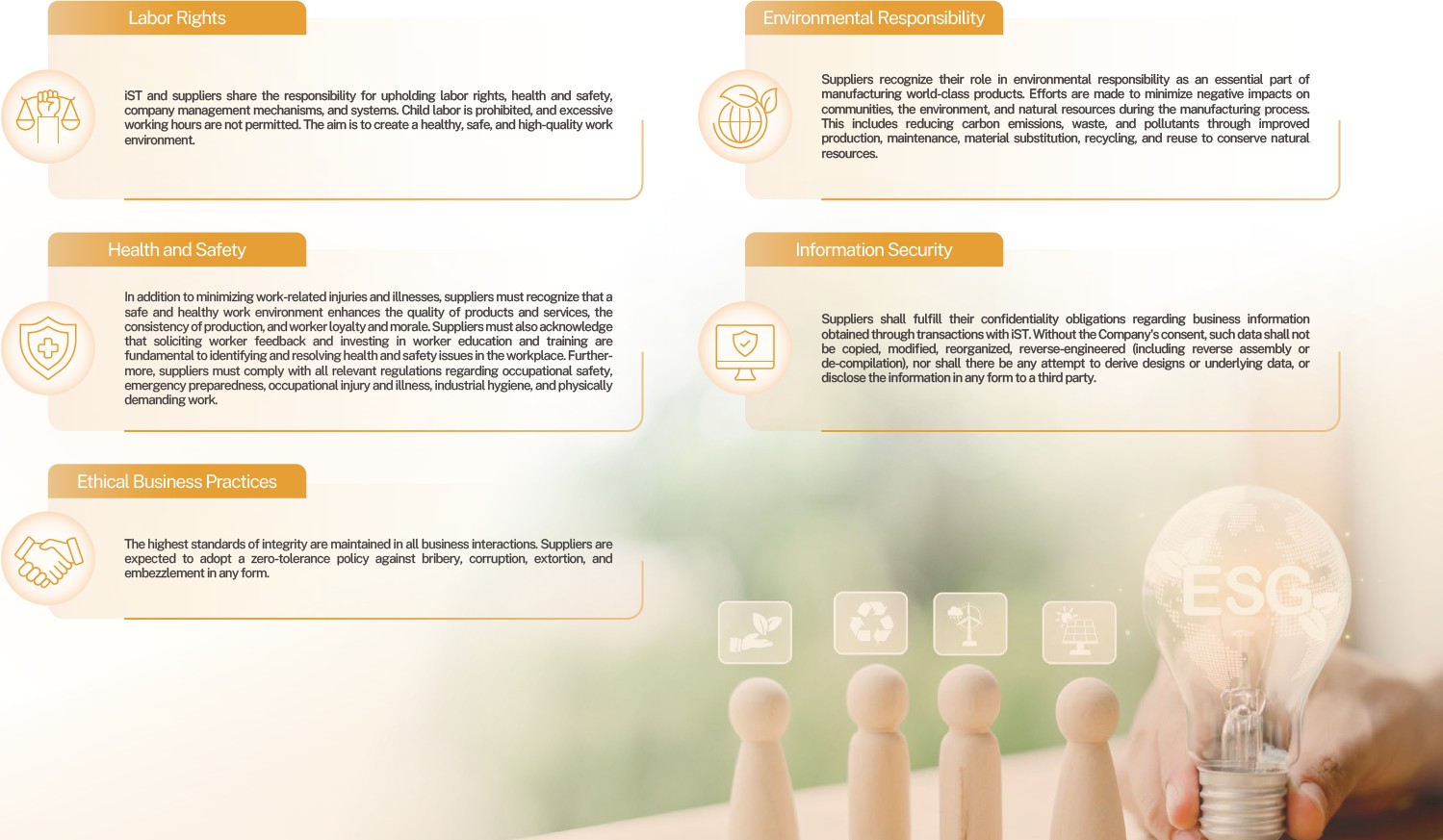
)iST upholds sustainable development, environmental friendliness, ethical business practices, and information security. The Company and its suppliers work together on environmental protection, safety, hygiene, and other related issues to fulfill corporate responsibilities. Based on these principles, the Company has established the Supplier Code of Conduct as attached, which serves as the standards for suppliers to follow. A summary is provided below:
Supplier Management Approach (Including Contractors)
Equipment suppliers are also required to sign an "Information Security Declaration" and are obligated to protect the customer information assets they obtain or use, ensuring they are shielded from unauthorized access, alteration, destruction, or improper disclosure. All 14 new equipment suppliers added in 2025 have completed the signing process.
iST prioritizes industrial safety and mandates that all construction contractors and equipment suppliers entering our premises undergo safety induction training provided by our Environmental Health and Safety (EHS) unit. In 2025, 14 safety education sessions were held with 200 participants. Waste disposal contractors must possess relevant certifications and comply with environmental regulations, signing a "Contractor Safety and Environmental Consent Agreement" to ensure adherence to safety and environmental management guidelines. A total of 20 new construction contractors and equipment suppliers for the current year have completed 100% signing of the agreements.
iST requires suppliers to commit to strict adherence to the Company's established integrity-related regulations. During the course of normal business transactions with iST, suppliers are obligated to refrain from engaging in any bribery, offering inducements, or providing undue benefits to iST employees or their associates in order to facilitate business interactions. Suppliers are strictly prohibited from influencing, persuading, or enticing iST employees to deviate from their duties or faithful obligations to the Company. Suppliers with substantial transaction amounts are required to sign the "Supplier Integrity Commitment Letter". In 2025, 31 new suppliers were added, all of whom signed and returned the document.
.jpg)
New Supplier Risk Assessment
To ensure supply quality, delivery stability, and risk control, iST conducts risk assessments during the new supplier onboarding stage in accordance with the "Suppliers Management Procedure" and "Procurement Management Procedure" to strengthen the supply chain management mechanism from the source.
iST evaluates key suppliers based on dimensions such as quality management systems, operational management processes, supply stability, anomaly handling mechanisms, and basic legal compliance capabilities, adopting a quantitative grading management approach:
.jpg)
Supplier Sustainability Audit
To strengthen supply chain sustainability management and mitigate potential environmental and social risks, iST has established a tiered supplier sustainability audit system based on supplier types and risk levels, adopting a dual-track management approach consisting of "document audits" and "on-site audits".
iST requires suppliers to submit improvement plans and undergoes follow-up management for any deficiencies identified during the audit process. In the event of major violations, the Company takes necessary actions in accordance with contractual specifications and its supplier management policy to ensure the supply chain aligns with the Company's sustainable business principles. In 2025, all suppliers identified with deficiencies during audits will commit to implementing corrective actions, achieving a 100% improvement rate for all identified issues.
.jpg)
Supplier Assessment
Annual assessments are conducted for Tier-1 suppliers with significant regular transactions, using cost, lead time, service, and process as scoring criteria. Suppliers with scores above 3.5 are considered qualified, 3.0 to 3.5 are conditionally approved, and below 3.0 are disqualified. In 2023, supplier ESG ratings for sustainability were integrated into the annual evaluation criteria. In 2023, supplier ESG ratings for sustainable operations were incorporated into the annual evaluation assessment. In 2025, 59 suppliers were assessed; all were qualified, and no serious ESG violations occurred.
In 2025, on-site assessments were performed for 5 key assembly plants and PCB manufacturers. In addition to evaluating supplier's process capabilities, quality, delivery control, and internal management processes, the assessment criteria have also included corporate social responsibility since 2023. This involves reviewing whether suppliers comply with corporate social responsibility standards regarding occupational safety, environmental protection, and labor rights. If any non-compliance is identified, suppliers are required to implement continuous improvements or face a reduction in procurement volume; in severe cases, business cooperation will be terminated.
In summary, when implementing our supply chain management, iST considers not only efficiency and costs, but also focuses on the performance of partners in various dimensions such as environment, society, and governance. Through regular evaluations, iST continuously understands the supplier operational status to enhance mutual sustainability, as well as encouraging the suppliers internalize ESG into their company management and operations. This will enhance the overall resilience and adaptability of iST's supply chain in facing unforeseen events, ensuring iST can consistently provide professional services to customers and maintain supply chain resilience.
Green and ESG Procurement Policy
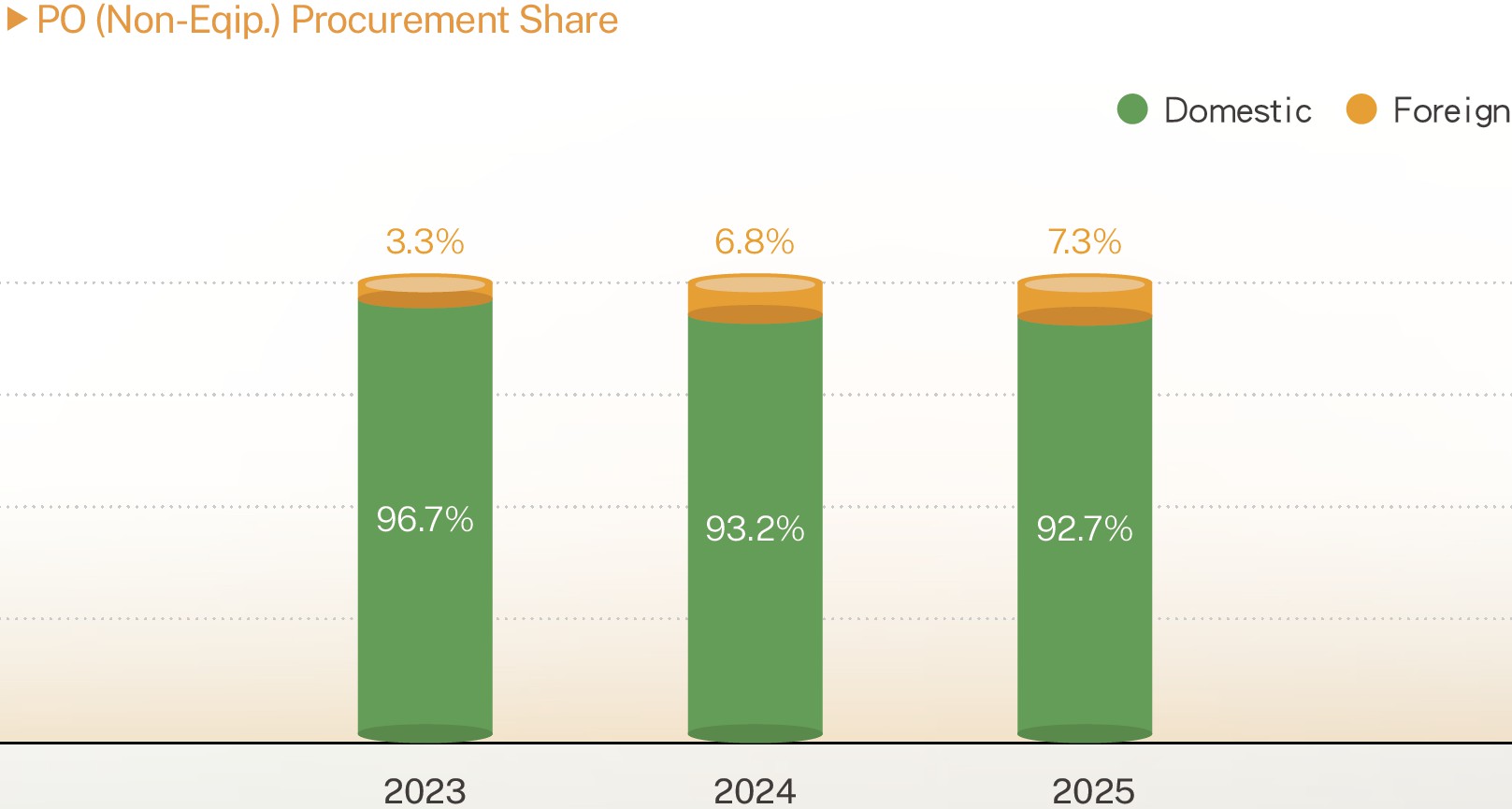
iST is a large third-party laboratory recognized by important domestic and international customers. The equipment purchased must meet customer verification requirements. Except for large-scale equipment, which must be purchased from internationally renowned manufacturers, other items such as regularly used consumables, instruments, chemicals, outsourcing services, and testing peripherals are procured with sustainable operation as the goal. Energy-saving and environmental protection factors in multiple aspects, including procurement, logistics, recycling, and reuse, are comprehensively considered to actively reduce the carbon footprint of value chain activities and jointly fulfill social responsibilities such as environmental protection, energy conservation, and emission reduction with suppliers. Priority is given to locally produced and environmentally friendly suppliers for goods (products with environmental labels and products recognized by the Ministry of Environment as containing recycled materials) to build a green supply chain. To strengthen supply chain resilience, iST actively developed 165 domestic suppliers in 2025 to ensure uninterrupted supply and maintain operating cost advantages. iST also requires all suppliers to confirm ESG matters when accepting orders. Statistics for the past three years show that, excluding large-scale equipment, the proportion of domestic procurement value has remained above 90% (as shown in the table below).
Conflict Minerals Sourcing Policy
Following OECD's "Due Diligence Guidance for Responsible Supply Chains of Minerals from Conflict-Affected and High-Risk Areas," iST establishes a framework for responsible investigation. In addition to advocating the "prohibition of the use of conflict minerals", suppliers are required to sign the "Declaration of Non-Use of Conflict Minerals" and provide supporting documentation during the annual supplier ESG survey. This process facilitates the evaluation of whether raw materials and components provided by suppliers contain conflict minerals. In 2025, a survey of 12 new PCB manufacturers or equipment suppliers was conducted, all of whom complied with the "Declaration of Non-Use of Conflict Minerals". All of these manufacturers or suppliers signed the "Declaration of Non-Use of Conflict Minerals", achieving a completion rate of 100%.
Creating a Sustainable Value Chain
The iST Value Chain is illustrated below:
iST regards supplier partners as operational collaborators in co-creating value. We aspire to construct a sustainable service value chain with suppliers to provide optimal solutions to our customers while reducing environmental and social risks, which build a proactive and responsible value chain network.
Policies and Objectives
Establish a supplier management system and relevant guidelines to meet requirements for quality, cost, delivery, service, technology, and ESG management, while requiring upstream supply chain management and suppliers’ commitment to fulfilling their corporate social responsibility.
Supplier Composition
As a third-party certification laboratory, iST has established Supplier Management Procedures and Procurement Management Procedures to ensure the provision of professional and timely service quality to important international customers. Suppliers are classified as follows: Grade I – PCB manufacturers and assembly manufacturers with annual transactions of more than NT$5 million; Grade II-A – domestic PCB manufacturers and BGA processing manufacturers with annual transactions of less than NT$5 million; Grade II-B – Socket agents and overseas PCB manufacturers; Grade III – facility engineering contractors, repair/maintenance service providers, and outsourced testing service providers; Grade IV – equipment suppliers and others; Grade V – chemical suppliers. Suppliers are managed by grade according to the attributes and importance of each supplier category.
Supply Chain Management System
• Supplier Code of Conduct ( For the full text, please refer to )
)iST upholds sustainable development, environmental friendliness, ethical business practices, and information security. The Company and its suppliers work together on environmental protection, safety, hygiene, and other related issues to fulfill corporate responsibilities. Based on these principles, the Company has established the Supplier Code of Conduct as attached, which serves as the standards for suppliers to follow. A summary is provided below:
Supplier Management Approach (Including Contractors)
Equipment suppliers are also required to sign an "Information Security Declaration" and are obligated to protect the customer information assets they obtain or use, ensuring they are shielded from unauthorized access, alteration, destruction, or improper disclosure. All 14 new equipment suppliers added in 2025 have completed the signing process.
iST prioritizes industrial safety and mandates that all construction contractors and equipment suppliers entering our premises undergo safety induction training provided by our Environmental Health and Safety (EHS) unit. In 2025, 14 safety education sessions were held with 200 participants. Waste disposal contractors must possess relevant certifications and comply with environmental regulations, signing a "Contractor Safety and Environmental Consent Agreement" to ensure adherence to safety and environmental management guidelines. A total of 20 new construction contractors and equipment suppliers for the current year have completed 100% signing of the agreements.
iST requires suppliers to commit to strict adherence to the Company's established integrity-related regulations. During the course of normal business transactions with iST, suppliers are obligated to refrain from engaging in any bribery, offering inducements, or providing undue benefits to iST employees or their associates in order to facilitate business interactions. Suppliers are strictly prohibited from influencing, persuading, or enticing iST employees to deviate from their duties or faithful obligations to the Company. Suppliers with substantial transaction amounts are required to sign the "Supplier Integrity Commitment Letter". In 2025, 31 new suppliers were added, all of whom signed and returned the document.
New Supplier Risk Assessment
To ensure supply quality, delivery stability, and risk control, iST conducts risk assessments during the new supplier onboarding stage in accordance with the "Suppliers Management Procedure" and "Procurement Management Procedure" to strengthen the supply chain management mechanism from the source.
iST evaluates key suppliers based on dimensions such as quality management systems, operational management processes, supply stability, anomaly handling mechanisms, and basic legal compliance capabilities, adopting a quantitative grading management approach:
Supplier Sustainability Audit
To strengthen supply chain sustainability management and mitigate potential environmental and social risks, iST has established a tiered supplier sustainability audit system based on supplier types and risk levels, adopting a dual-track management approach consisting of "document audits" and "on-site audits".
iST requires suppliers to submit improvement plans and undergoes follow-up management for any deficiencies identified during the audit process. In the event of major violations, the Company takes necessary actions in accordance with contractual specifications and its supplier management policy to ensure the supply chain aligns with the Company's sustainable business principles. In 2025, all suppliers identified with deficiencies during audits will commit to implementing corrective actions, achieving a 100% improvement rate for all identified issues.
Supplier Assessment
Annual assessments are conducted for Tier-1 suppliers with significant regular transactions, using cost, lead time, service, and process as scoring criteria. Suppliers with scores above 3.5 are considered qualified, 3.0 to 3.5 are conditionally approved, and below 3.0 are disqualified. In 2023, supplier ESG ratings for sustainability were integrated into the annual evaluation criteria. In 2023, supplier ESG ratings for sustainable operations were incorporated into the annual evaluation assessment. In 2025, 59 suppliers were assessed; all were qualified, and no serious ESG violations occurred.
In 2025, on-site assessments were performed for 5 key assembly plants and PCB manufacturers. In addition to evaluating supplier's process capabilities, quality, delivery control, and internal management processes, the assessment criteria have also included corporate social responsibility since 2023. This involves reviewing whether suppliers comply with corporate social responsibility standards regarding occupational safety, environmental protection, and labor rights. If any non-compliance is identified, suppliers are required to implement continuous improvements or face a reduction in procurement volume; in severe cases, business cooperation will be terminated.
In summary, when implementing our supply chain management, iST considers not only efficiency and costs, but also focuses on the performance of partners in various dimensions such as environment, society, and governance. Through regular evaluations, iST continuously understands the supplier operational status to enhance mutual sustainability, as well as encouraging the suppliers internalize ESG into their company management and operations. This will enhance the overall resilience and adaptability of iST's supply chain in facing unforeseen events, ensuring iST can consistently provide professional services to customers and maintain supply chain resilience.
Green and ESG Procurement Policy
iST is a large third-party laboratory recognized by important domestic and international customers. The equipment purchased must meet customer verification requirements. Except for large-scale equipment, which must be purchased from internationally renowned manufacturers, other items such as regularly used consumables, instruments, chemicals, outsourcing services, and testing peripherals are procured with sustainable operation as the goal. Energy-saving and environmental protection factors in multiple aspects, including procurement, logistics, recycling, and reuse, are comprehensively considered to actively reduce the carbon footprint of value chain activities and jointly fulfill social responsibilities such as environmental protection, energy conservation, and emission reduction with suppliers. Priority is given to locally produced and environmentally friendly suppliers for goods (products with environmental labels and products recognized by the Ministry of Environment as containing recycled materials) to build a green supply chain. To strengthen supply chain resilience, iST actively developed 165 domestic suppliers in 2025 to ensure uninterrupted supply and maintain operating cost advantages. iST also requires all suppliers to confirm ESG matters when accepting orders. Statistics for the past three years show that, excluding large-scale equipment, the proportion of domestic procurement value has remained above 90% (as shown in the table below).
Conflict Minerals Sourcing Policy
Following OECD's "Due Diligence Guidance for Responsible Supply Chains of Minerals from Conflict-Affected and High-Risk Areas," iST establishes a framework for responsible investigation. In addition to advocating the "prohibition of the use of conflict minerals", suppliers are required to sign the "Declaration of Non-Use of Conflict Minerals" and provide supporting documentation during the annual supplier ESG survey. This process facilitates the evaluation of whether raw materials and components provided by suppliers contain conflict minerals. In 2025, a survey of 12 new PCB manufacturers or equipment suppliers was conducted, all of whom complied with the "Declaration of Non-Use of Conflict Minerals". All of these manufacturers or suppliers signed the "Declaration of Non-Use of Conflict Minerals", achieving a completion rate of 100%.
